

Employee Retention in the IT-sector

Employee Retention

The IT industry is a dynamic and fast-moving sector in which HR departments are constantly on the lookout for qualified and committed employees. However, employee retention, i.e. the ability to retain employees in the long term, remains a major challenge. After all, in an industry where demand for skilled workers is high, it remains tempting for employees to take on a new challenge and leave the company. But how can companies in the IT industry increase the retention of their employees?

The 4 most important elements for strong employee retention

Below, DearEmployee has summarized the four most important elements to sustainably improve your employee retention. By implementing these, you can become a magnet for skilled workers and ensure that processes like “The Great Resignation” pass by.

1. Employee Experience

Employee Experience describes the experience of the employees within the company. The aim is to optimize it through better working conditions and processes in order to increase employee satisfaction. Such a development can be achieved by improving the workplace culture, promoting career development or optimizing the work-life balance.

2. Employee Engagement

Another way to improve employee retention is to increase employee participation. Involvement in decision-making processes shows employees that their opinions and ideas are valued. Appreciation makes people happy. This also increases identification with the company. Therefore, employees should have a say in decisions, as this influences their loyalty to the company in the long term.

3. Further Training

An integral part of the employee experience and an increasingly important goal of employees, the provision of continuing education remains an important driver of longer-term employment. Providing employees with continuing education not only increases loyalty, but also improves the services provided. This offer makes employees feel challenged and gives them the chance to advance their career noticeably in the same company.

4. Working Environment

Finally, an important element is a positive and supportive work environment. The art here is to create a culture that encourages employees to contribute their skills and talents. Mutual support strengthens the social relationships between employees and welds them together in the long term. In addition, a positive work environment makes employees feel comfortable and willing to give their best.

Employee retention has top priority in the IT industry

Finally, it is important to emphasize that the retention of IT employees is not only a task of human resources, but also of managers. Good leadership that understands the needs and goals of its employees can help increase employee engagement and loyalty. Furthermore, it requires a combination of different measures and an ongoing adaptation to the changing needs and desires of employees. Companies should regularly review the satisfaction and motivation of their employees and make adjustments where necessary. In the IT industry, where the demand for qualified professionals is high, it is important that companies prioritize the retention of their employees. By implementing measures to improve the employee experience, employee engagement and training and development, and by creating a positive and supportive work environment, companies in the IT industry can retain their employees over the long term and be considered an attractive employer.

Want to know how to actively improve your employee retention in your company? 

Let’s talk #Makingworkabetterplace
Make an appointment now

Häufig gestellte Fragen zur GBPsych-Dokumentation

Was muss bei der GBPsych dokumentiert werden?

Vier Bestandteile: Ergebnisse, Maßnahmen, Durchführungs- und Wirksamkeitskontrolle.

Gemäß §6 ArbSchG müssen vier Bestandteile dokumentiert werden: die Ergebnisse der Gefährdungsbeurteilung nach Bereichen und Belastungsdimensionen, die festgelegten Maßnahmen mit Verantwortlichen und Fristen, die Überprüfung der Durchführung sowie die Überprüfung der Wirksamkeit. Eine Dokumentation, die nur den Befragungsprozess, nicht aber Maßnahmen und Wirksamkeitskontrolle enthält, ist nach §6 ArbSchG unvollständig.

Wie lange muss die GBPsych-Dokumentation aufbewahrt werden?

Mindestens 5 Jahre nach Abschluss eines GBPsych-Zyklus.

Das ArbSchG nennt keine exakte Frist. In der Praxis haben sich mindestens 5 Jahre nach Abschluss eines GBPsych-Zyklus als Standard etabliert. Bei Erkrankungen mit möglichem Arbeitsbezug gelten analog zu Berufskrankheitenregelungen bis zu 30 Jahre. Empfehlenswert ist eine digitale Ablage mit automatischer Versionierung und Zeitstempel.

Ist eine Excel-Tabelle als GBPsych-Dokumentation ausreichend?

Formal ja, praktisch oft problematisch.

Rechtlich ist jedes Format zulässig, das schriftlich oder in vergleichbarer Weise elektronisch vorliegt (§6 ArbSchG). Eine Excel-Tabelle ist also formal erlaubt, muss aber alle vier Pflichtbestandteile vollständig enthalten, und nachträgliche Änderungen müssen erkennbar sein. In der Praxis scheitern Excel-Dokumente oft an Versionsproblemen und fehlender Wirksamkeitskontrolle.

Was passiert, wenn die GBPsych-Dokumentation bei einer Kontrolle fehlt?

Bußgelder bis zu 30.000 Euro nach §25 ArbSchG sind möglich.

Fehlende oder unvollständige Dokumentation gilt als Verstoß gegen §6 ArbSchG. Die Gewerbeaufsicht oder Berufsgenossenschaft kann Mängelhinweise, Verwarnungen oder Bußgelder bis zu 30.000 Euro nach §25 ArbSchG aussprechen. Bei wiederholten Verstößen oder Unfällen können die Konsequenzen erheblich größer ausfallen.

Mehr zu Strafen und Bußgeldern
Muss die GBPsych digital dokumentiert werden oder reicht Papier?

Beide Formate sind erlaubt, digital hat klare Praxisvorteile.

§6 ArbSchG verlangt eine schriftliche oder vergleichbar elektronische Dokumentation, beide Formate sind also zulässig. Entscheidend ist, dass die Dokumentation jederzeit zugänglich, dauerhaft lesbar und gegen unbemerkte nachträgliche Änderungen geschützt ist. Digitale Lösungen bieten Durchsuchbarkeit, Zugriffsrechte, automatische Fristenerinnerung und eine lückenlose Versionshistorie, Papierablage ist erlaubt, aber fehleranfälliger.

Welche Rechte hat der Betriebsrat bei der GBPsych-Dokumentation?

Der Betriebsrat hat ein Einsichtsrecht nach §80 BetrVG.

Der Betriebsrat hat nach §80 BetrVG ein Einsichtsrecht in die Dokumentation der Gefährdungsbeurteilung, die gewählte Ablageform muss dieses praktisch ermöglichen. Zusätzlich besteht bei der Ausgestaltung des Verfahrens eine Mitbestimmung nach §87 BetrVG. Die Einbindung des Betriebsrats sollte selbst dokumentiert werden, da fehlende Nachweise dazu bei Kontrollen als Mangel gewertet werden können.

GB Psych und Betriebsrat
Gilt die Dokumentationspflicht auch für Betriebe unter 10 Beschäftigten?

Ja, die bisherige Ausnahme entfällt ab 2025/2026 schrittweise.

Die Dokumentationspflicht nach §6 ArbSchG gilt grundsätzlich für alle Betriebe mit mindestens einem Beschäftigten. Für Betriebe mit bis zu 10 Beschäftigten galt bislang eine vereinfachte Ausnahmeregelung, die 2025/2026 schrittweise entfällt. Damit müssen sich auch kleine Betriebe auf eine vollständige, nachvollziehbare Dokumentation einstellen.

Mehr zur GBPsych-Pflicht 2026
Wann muss die Wirksamkeit der Maßnahmen überprüft werden?

Laut BAuA spätestens 12–18 Monate nach Maßnahmeneinführung.

Die Wirksamkeitskontrolle ist der am häufigsten übersprungene Bestandteil, ohne ihn ist die GBPsych nach §6 ArbSchG unvollständig. Die BAuA empfiehlt, die Überprüfung spätestens 12–18 Monate nach Einführung einer Maßnahme durchzuführen, etwa über eine Nachbefragung, ein Feedbackgespräch oder ein erneutes Assessment in der betroffenen Gruppe, jeweils mit dokumentiertem Ergebnis.

Maßnahmen ableiten und umsetzen

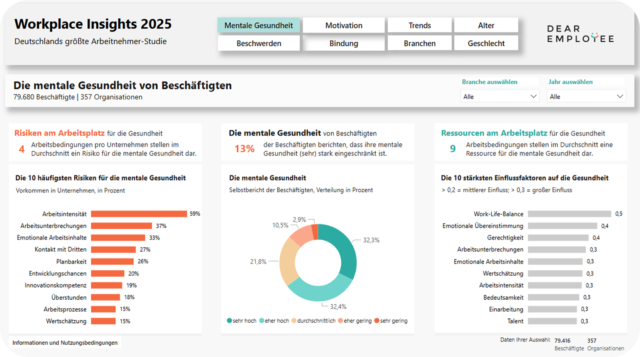
Workplace Insights

Wie geht es Deiner Branche?
Finde es heraus im interaktiven Dashboard
zur Arbeitswelt von heute

  • Group-1-320x159

Employee Retention in the IT-sector

The IT industry is a dynamic and fast-moving sector in …

Fachkräftemangel – wie verhindern?

Fachkräftemangel durch mentale Belastungen Fast vierzehn Prozent der Beschäftigten in …